
What Straight Couples Can Learn From Queer Weddings

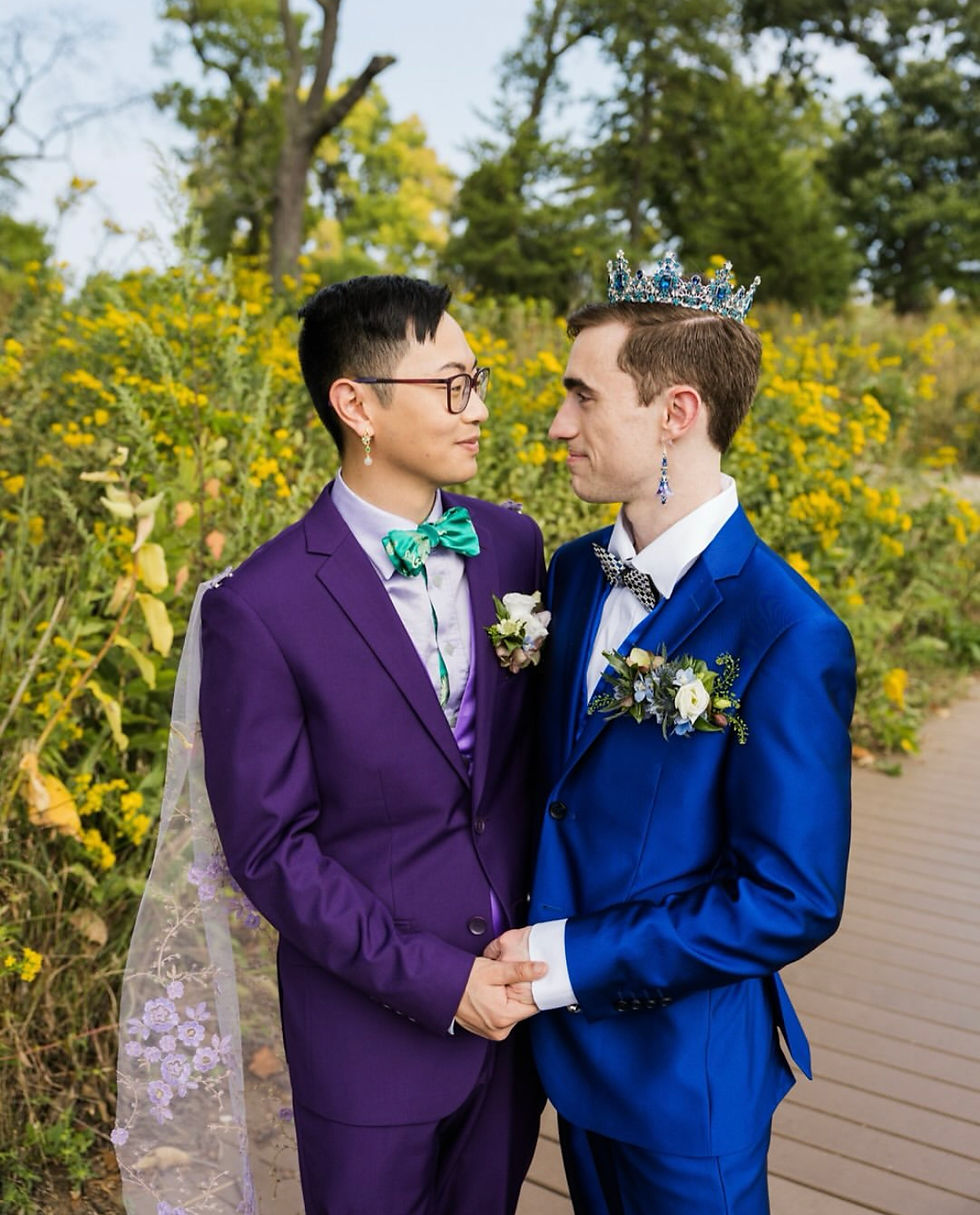
Over the years, I’ve become known as one of Chicago’s go-to planners for queer weddings. While a large portion of my clients are queer couples, I also work with plenty of straight couples, and I’ve noticed some interesting differences in how each group approaches wedding planning.
To be clear, I don’t think queer couples are inherently better planners. But I do think the experience of being queer often creates a different lens through which couples approach their weddings. Many queer couples are accustomed to questioning traditions, examining expectations, and intentionally deciding what does and doesn’t belong in their lives.
The experience of being queer has often required couples to spend years asking questions like:
Who belongs in our lives?
Which traditions serve us?
What kind of family are we building?
What expectations are we willing to reject?
What values do we want to prioritize?
By the time wedding planning begins, many queer couples have already spent years exercising that discernment muscle. They bring that same intentionality into the planning process, resulting in celebrations that feel deeply personal and purposefully designed.
And I think there's a lot all couples can learn from that approach.
Values Come Before Traditions
One of the biggest differences I notice when planning queer weddings is where couples begin.
Many straight couples start planning from a place of tradition. They begin with the wedding script they've inherited from family, friends, social media, and the wedding industry. The questions often sound like: What are we supposed to do? What's normal? What comes next?
Many queer couples, on the other hand, start from a different place entirely. They begin by asking what feels meaningful to them.
That's not because queer couples don't value tradition; many do. But because so many wedding traditions weren’t created with queer couples in mind, they often have to decide intentionally which traditions they want to keep, which they want to modify, and which they want to leave behind.
The result is that traditions become choices rather than obligations.
And that's a lesson I think all couples can benefit from. The most meaningful weddings aren't necessarily the ones that follow every tradition. They're the ones where each tradition that is included has a purpose.
More Intentional Guest Lists
If there is one area where I consistently see queer couples approach wedding planning differently, it's the guest list.
Many queer people have spent years building community, identifying their support systems, and learning who truly shows up for them. For some, that has meant navigating difficult family relationships. For others, it has meant building a chosen family alongside or in lieu of their biological one.
Because of that, guest lists are often approached through the lens of connection rather than obligation.
The question becomes less about who might be offended if they aren't invited and more about who actively participates in the couple's lives.
That's not to say guest lists are easy. They rarely are. But I often see queer couples feeling more empowered to make decisions based on the health and reality of a relationship rather than the expectation that someone deserves an invitation simply because they're expected to receive one.
I think every couple deserves permission to ask:
Who do we genuinely want to celebrate with?
Instead of:
Who will be upset if we don't invite them?
Less Attachment to the "Right Way"
Wedding planning is full of rules.
There are rules about timelines, attire, wedding parties, ceremonies, receptions, speeches, and just about everything else you can imagine.
But one thing I've learned from planning queer weddings is that many queer couples are less concerned with whether something is being done the "right" way and more concerned with whether it feels right for them.
Maybe both partners walk down the aisle.
Maybe there is a joint wedding party instead of one divided by sides.
Maybe instead of a parent dance, there is a special people dance that includes their best friends.
Maybe no one is "given away".
Maybe there is no bride or groom.
Maybe there is no focus on 2 becoming 1.
Instead of automatically accepting the traditional answer, queer couples often pause and ask a different question:
Does this reflect us, our lifestyle, and our definition of love?
That mindset creates space for creativity, authenticity, and personalization. It also removes a tremendous amount of pressure.
Because the goal isn't to create the perfect wedding according to someone else's standards. The goal is to create a wedding that feels like an honest reflection of the people getting married.
More Focus on Community
Possibly my favorite lesson from queer weddings is the emphasis on community.
At their core, weddings are about relationships. Not just the relationship between two partners, but the network of people who have supported, encouraged, and loved them along the way.
Most queer couples understand this deeply.
Historically, queer communities have often relied on chosen family, mutual support, and community care. As a result, weddings frequently become celebrations not only of a partnership, but of the village that helped make that partnership possible.
I often see queer couples thinking intentionally about how guests will experience the wedding, how people will connect with one another, and how to create an environment where everyone feels welcome and included.
The focus is less on performance and more on gathering.
Less on impressing people and more on appreciating them.
And while every wedding is different, I think there is something incredibly powerful about approaching a wedding not just as a celebration of a couple, but as a celebration of community.
Ultimately, these aren't lessons that belong exclusively to queer couples. They're lessons available to anyone willing to approach wedding planning with curiosity, intention, and a willingness to question expectations.
The biggest lesson queer weddings have taught me over the years isn't about guest lists, traditions, or wedding formats. It's that the most meaningful celebrations are rarely built by following a script. They're built by taking the time to ask what matters, who matters, and what kind of experience you want to create.
Whether you're planning a wedding that feels deeply traditional, completely unconventional, or somewhere in between, the goal isn't to get it "right." The goal is to create a celebration that feels like an honest reflection of your relationship, your values, and your community.
And if there's one thing I've learned from the queer couples I've had the privilege of working with, it's that there is something incredibly powerful about building a wedding intentionally instead of inheriting one by default.
If you're looking for a planning experience that's centered on intentionality rather than expectation, schedule a planning info call here.


Comments